


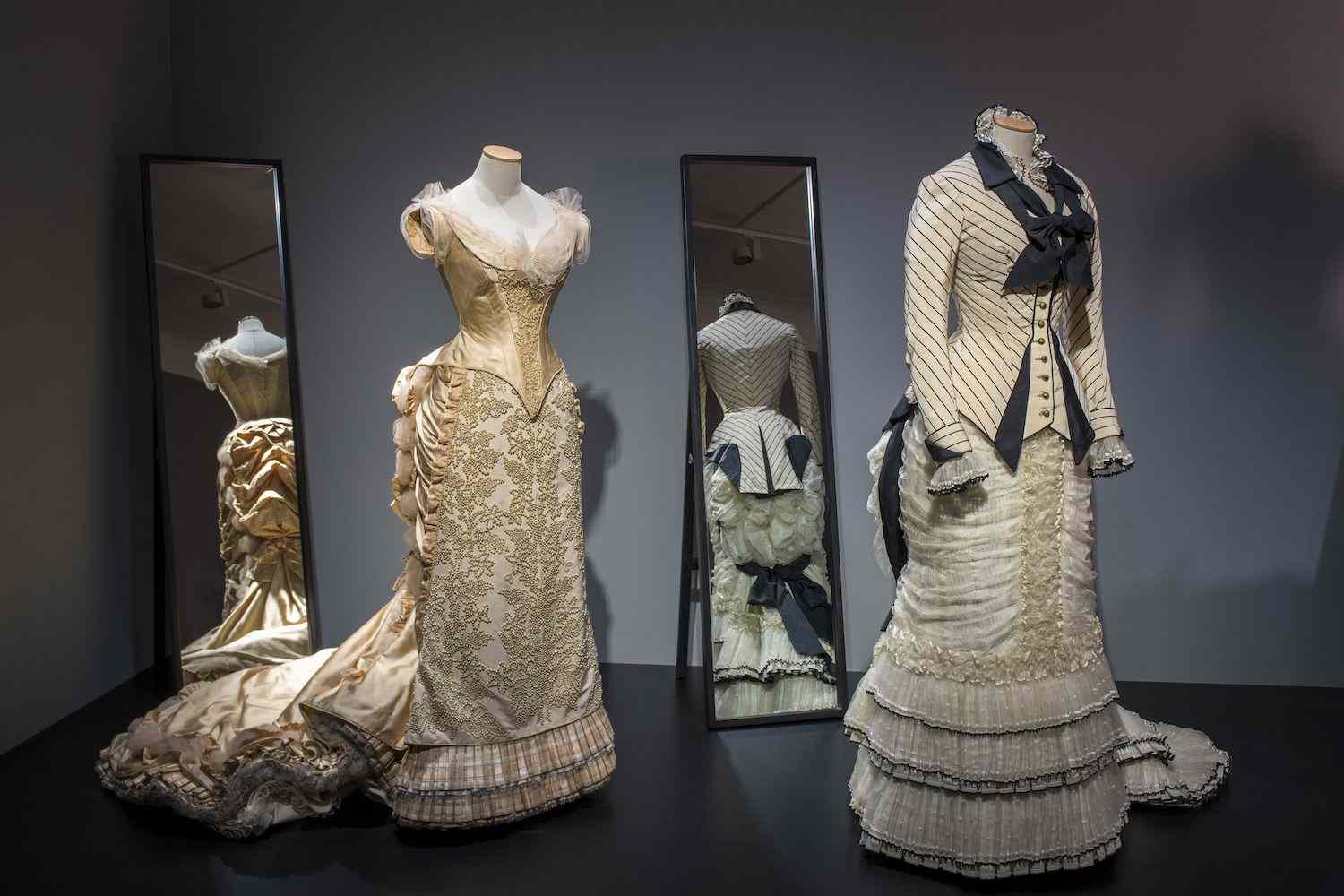
Imagine standing in a Fifth Avenue ballroom in 1883. The chandeliers blaze. Around you, women glide across the floor in gowns that weigh as much as a small child, each one a sculpted tower of silk, beading, and architectural undergarments. One dress alone could cost more than a working family earned in a year.
This wasn’t just clothing. It was Gilded Age fashion at its most extravagant. It was a battlefield, and the weapons were made of satin.
The Gilded Age, roughly the 1870s through the turn of the century, was an era of staggering American wealth. Railroad barons and industrialists amassed fortunes never before seen. And their wives turned that money into something visible, wearable, and impossible to ignore. In Gilded Age fashion, every gown was a statement of exactly where a family stood in the brutal hierarchy of high society.
Here’s what most people get wrong about this period. They picture pretty dresses and leave it at that. But Gilded Age fashion was a complex language, with strict rules about what you wore, when you wore it, and who designed it. Break those rules, and you announced yourself as an outsider.
What makes Gilded Age fashion so fascinating today is how dramatically the silhouettes shifted across just thirty years. The bustled gowns of the 1870s look nothing like the hourglass figures of the 1890s. Each decade rewrote the rules of Gilded Age fashion.
By the end of this guide, you’ll understand the iconic silhouettes, the legendary designers, the social codes, and why this opulent, restrictive, gloriously excessive style still captivates us today.
Strategic Executive Summary
Gilded Age fashion reflected one of the wealthiest, most status-obsessed periods in American history. This guide explores the silhouettes, designers, social rules, and lasting influence of clothing from the 1870s through the 1890s.
You’ll discover how Gilded Age fashion evolved across three distinct phases. The bustle-heavy 1870s, the structured second bustle period of the 1880s, and the hourglass leg-of-mutton look of the 1890s each tell a different story. Understanding this evolution is the key to recognizing Gilded Age fashion at a glance.
You’ll meet the era’s defining designer, Charles Frederick Worth, the father of haute couture, whose Paris house dressed the Astors, Vanderbilts, and every elite family that mattered. His name on a label meant you’d arrived.
You’ll also learn the hidden architecture behind Gilded Age fashion. Corsets, bustles, steel boning, and layers of petticoats created those dramatic shapes. The undergarments were engineering marvels, and they shaped not just the silhouette but how women moved and lived.
Beyond women’s fashion, you’ll explore the refined world of men’s dress, from top hats and tailored suits to walking sticks and gloves. Men’s style was quieter but equally coded with meaning.
Most importantly, you’ll understand fashion as social language. In this era, clothing communicated wealth, status, taste, and belonging. Specific occasions demanded specific outfits, and knowing the rules separated insiders from outsiders. By the end, you’ll see why this dazzling, demanding style still inspires designers, collectors, and television audiences today.
What Was Gilded Age Fashion?
Gilded Age fashion refers to the opulent clothing styles worn in the United States from roughly the 1870s through the 1890s. Defined by luxury, excess, and elaborate silhouettes, it used fashion as a visible display of immense new wealth.
The term Gilded Age itself hints at the fashion. It describes a period that looked golden on the surface, glittering with wealth, even as deeper social inequalities lay beneath. Gilded Age fashion became the most visible expression of that gilding.
This was an era of extraordinary American fortunes. Industrialists and financiers built empires, and their families spent lavishly to prove their place in society. Gilded Age fashion became the primary tool for that proof.
The style is best described as luxurious, glamorous, and elegant. Women’s gowns were floor-length, heavily layered, and richly decorated with embroidery, beading, lace, and the finest imported silks. Every detail signaled money and refinement.
What makes the period so visually interesting is constant change. Unlike eras with one dominant look, Gilded Age fashion shifted noticeably across each decade. A woman dressed in 1875 would look distinctly out of place by 1895. These shifts mattered, because keeping up with the latest silhouette was itself a sign of status and means.
Gilded Age fashion was never just about looking beautiful. It was about belonging to an exclusive world, and broadcasting that belonging to everyone who saw you.
The Bustle Era: 1870s Women’s Fashion
The 1870s introduced the bustle, a framework that added dramatic fullness to the back of a skirt. Paired with corsets, layered underskirts, and rich decoration, this silhouette defined early Gilded Age women’s fashion.
Early Gilded Age fashion opened with one unmistakable feature: the bustle. This was a structured framework built inside the back of a dress, creating a pronounced projection that supported cascades of draped fabric.
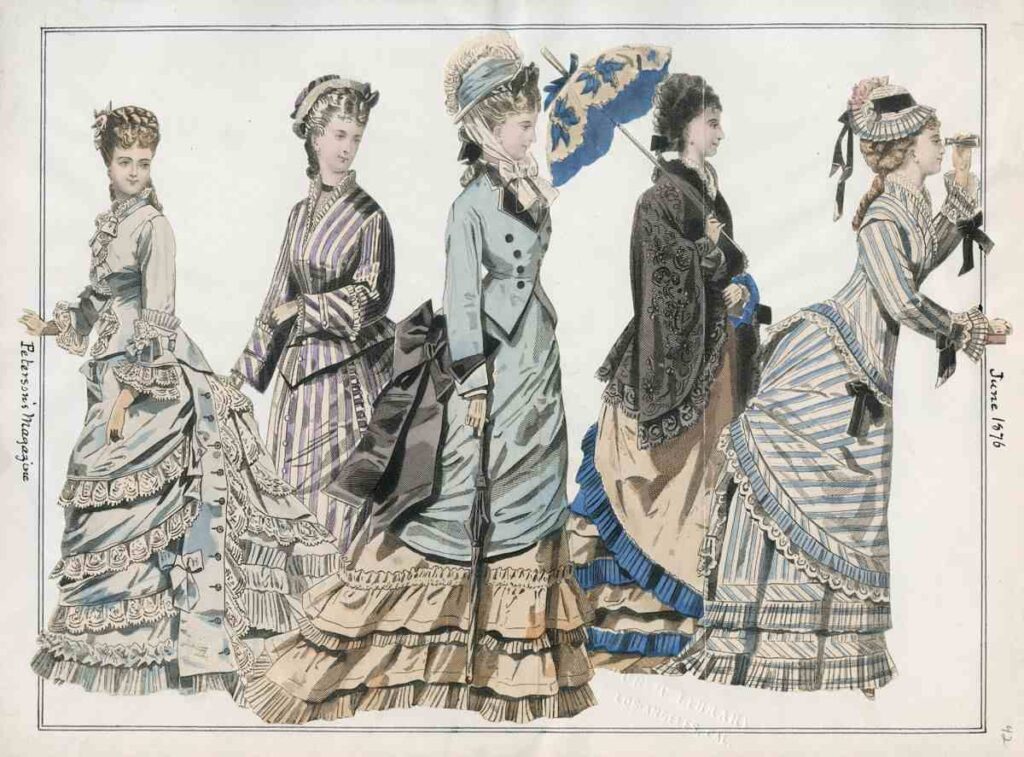
Underskirts with ruffles and pleats added volume, and dresses were often cut away in the back to reveal these decorative layers. The effect was elaborate, theatrical, and unmistakably expensive, since all that draping required enormous amounts of fabric.
Color and decoration ran bold. Women wore brightly colored and earth-toned gowns trimmed with ribbons, lace, and intricate folds. The more ornate the trim, the clearer the message of wealth.
Interestingly, the bustle briefly faded around 1877. For the final years of the decade, dresses became more form-fitting, creating a slender silhouette achieved through tightly laced corsets and boned bodices. This slimmer line was only a pause, though, because the bustle would return with force in the 1880s.
For formal occasions, evening gowns featured sloped, off-shoulder necklines and small sleeves, trimmed in silk and lace and paired with gloves. Women also began tying ribbons around the neck that trailed down the back, an early ancestor of the modern choker.
The Second Bustle Period: 1880s Fashion
The 1880s brought the bustle back, but reshaped. The new version sat closer to the body, was more geometric, and was often built from steel caging. This decade represented the structural peak of Gilded Age silhouettes.
After its brief disappearance, the bustle returned transformed. In 1881, Charles Worth redefined the earlier sweeping shape into a smaller, rounded half-dome that sat closer to the body.
By the mid-1880s, this bustle had become shorter, more geometric, and primarily constructed from steel caging. In France it was called the crinolette, named for its engineering resemblance to the full cage crinolines of earlier decades. The undergarments had become genuine feats of construction.
Corsets in this period were long-bodied and tightly fitted at the waist, made from silk, cotton, linen, or leather and reinforced with steel boning. A curved steel busk shaped the corset snugly over the lower torso, sculpting the body into the fashionable line.
Daytime brought variety in dress for different activities. Walking dresses came with prominent hats for public strolls. Dark-colored traveling attire emphasized practicality and propriety. Riding habits featured fitted jackets and long skirts for equestrian pursuits. Each activity had its own correct costume.
Evening dress reached the height of extravagance, with lower necklines, defined silhouettes enhanced by trains and bustles, and sumptuous fabrics like tulle and silk. Intricate hairstyles, gloves, and fans completed an ensemble designed to advertise family wealth.
The Hourglass Shift: 1890s Fashion
The 1890s abandoned the bustle entirely for a new hourglass silhouette. Wide leg-of-mutton sleeves, narrow corseted waists, and bell-shaped skirts created a fresh, dramatic shape that closed out the Gilded Age.
The turn of the decade brought one of the biggest transformations in Gilded Age fashion. The elaborate bustled gowns with sweeping trains gave way to something cleaner and more sculptural.
The defining feature was the leg-of-mutton sleeve. These sleeves puffed up and out dramatically at the shoulder before narrowing tightly at the wrist, resembling a leg of lamb, which gave them their name. Yokes, ruffles, and trims further emphasized the broad shoulders.
The overall silhouette became the famous hourglass: wide at the shoulders, narrow at the waist, and wide again at the hips. This shape relied on a tightly laced, heavily boned corset preshaped into the hourglass form.
Skirts changed too. The bustle morphed into a small, nonintrusive skirt pad, and skirts now fit smoothly over the hips before flaring into a bell shape at the hem. The overall look simplified compared to the heavily draped earlier decades.
This period also sparked controversy. The tight lacing required for the hourglass figure prompted a reform movement, as medical professionals and others raised concerns about the health effects of severely constricting corsets. Fashion’s demands and women’s wellbeing had begun to openly collide.
The House of Worth: Designing for the Elite
Charles Frederick Worth and his House of Worth were the defining designers of Gilded Age fashion. Based in Paris and widely considered the father of haute couture, Worth dressed America’s wealthiest women and set the era’s trends.
No name carried more weight in Gilded Age fashion than Worth. If you asked an elite woman of the era who made her gown, the answer was almost always the same: the House of Worth.
Charles Frederick Worth founded the house in Paris in 1858. Born in England, he apprenticed with textile merchants before relocating to Paris, where he eventually built the most prestigious fashion house in the world. Many credit him as the father of haute couture itself.
Worth’s influence on Gilded Age fashion went beyond individual gowns. He actively shaped trends, even promoting the bustle in part to stimulate France’s silk manufacturing industry. When Worth favored a silhouette, the elite world followed.
His clientele read like a roster of Gilded Age society. Women with names like Astor and Vanderbilt wore Worth gowns, knowing that his house maintained relationships with the finest silk purveyors in Lyon. These women understood fabric and quality intimately, and they had the fortunes to buy whatever they desired.
A Worth label transformed a dress into a status symbol. It signaled not just wealth, but taste, connections, and membership in an exclusive transatlantic elite. Today, museums like the Metropolitan Museum of Art preserve Worth gowns as masterpieces of the era.
Gilded Age Men’s Fashion
Men’s Gilded Age fashion was refined and restrained compared to women’s. It centered on tailored suits, top hats, high collars, and accessories like walking sticks and gloves, projecting dignity, propriety, and quiet wealth.
While women’s Gilded Age fashion dazzled, men’s dress communicated through subtlety. The look was solemn, polished, and deeply coded with respectability.
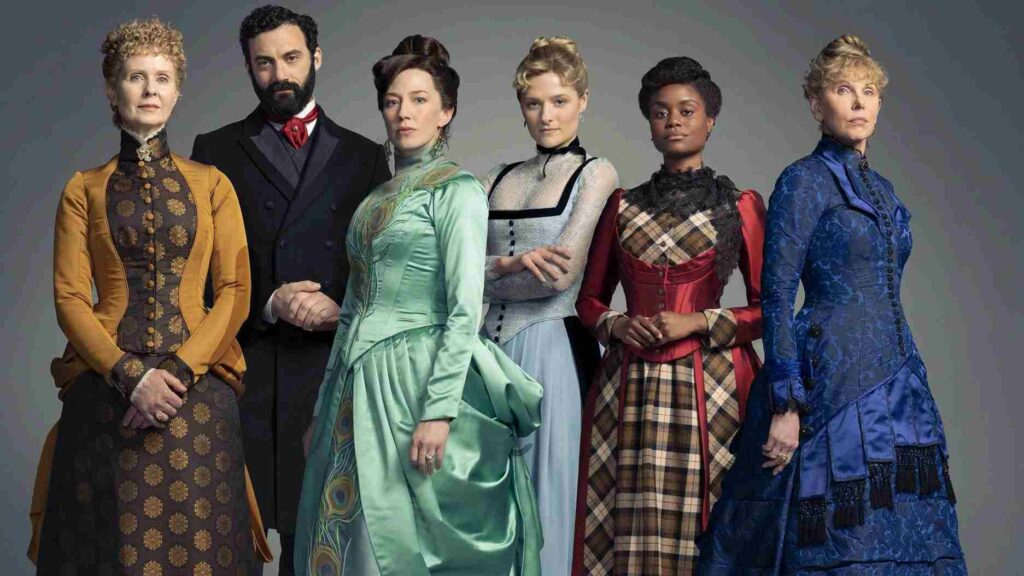
The foundation was the tailored suit. In the bustle decades, men wore structured three-piece suits in dark, serious colors. The fit and fabric quality, rather than flashy decoration, signaled a man’s standing.
Accessories completed the gentleman’s image. Top hats crowned formal looks, high collars framed the face, and walking sticks and gloves added refinement to a man strolling through the city. Every element reinforced an image of dignity and control.
Men’s fashion did evolve, just more quietly than women’s. As the 1890s arrived, the rigidly tailored suits of earlier decades gave way to somewhat more casual and comfortable styles. The shift mirrored the broader loosening of silhouettes happening across fashion.
Still, the core message stayed constant. A well-dressed Gilded Age man projected stability, success, and belonging, achieving through cut and quality what women achieved through volume and ornament.
Fashion as Social Language
In the Gilded Age, clothing was a precise social code. Specific occasions demanded specific outfits, and knowing the rules marked you as an insider. Fashion communicated wealth, status, taste, and belonging in a rigidly stratified society.
To truly understand Gilded Age fashion, you have to see it as a language with strict grammar.
A wealthy woman changed clothes multiple times a day, each outfit matched to its purpose. A morning might begin with a loose tea gown for receiving guests casually at home. An afternoon walk required a walking dress with the appropriate hat. A formal evening demanded a corset, bustle, and elaborate gown of beaded silk.
Wearing the wrong outfit for the occasion was a genuine social misstep. The rules weren’t arbitrary decoration. They were tests of whether you truly belonged to high society or were merely imitating it.
This is why French couture mattered so deeply. Elite women didn’t just buy expensive clothes. They demonstrated knowledge, knowing the best designers, the finest Lyon silks, and the latest Paris silhouettes. That knowledge itself was a form of social currency.
Fashion, in other words, did real work. It sorted people, announced fortunes, and maintained the boundaries of an exclusive world. A gown was never just beautiful. It was a carefully calibrated message about exactly who its wearer was.
Why Gilded Age Fashion Still Captivates Us
The opulence of this era continues to fascinate, and not by accident. There’s something endlessly compelling about a time when clothing carried such enormous meaning and demanded such extraordinary craftsmanship.
Modern audiences encounter this world through film and television, where lavish recreations of Gilded Age society bring the gowns roaring back to life. Seeing those silhouettes in motion reminds us how dramatic and demanding the fashion truly was.
Designers still draw on the era’s elements too. Corset-inspired bodices, dramatic sleeves, and sculptural silhouettes resurface regularly on modern runways, proving the period’s lasting influence on contemporary style.
Collectors and museums preserve original gowns as art, studying the engineering and artistry hidden in every seam. These garments survive as testaments to a moment when fashion reached a peak of excess and skill.
Perhaps the deepest appeal is the storytelling. Every Gilded Age gown carries a narrative of wealth, ambition, and social warfare conducted in silk and steel. That drama, as much as the beauty, keeps us captivated.
Frequently Asked Questions
Q: What years are considered the Gilded Age in fashion?
A: Gilded Age fashion generally spans the 1870s through the 1890s. This period saw rapid shifts from bustle silhouettes to the hourglass shape, all defined by luxury and visible displays of wealth.
Q: What is a bustle in Gilded Age fashion?
A: A bustle is a framework built into the back of a dress to add fullness and support draped fabric. It defined the 1870s and 1880s silhouettes and used large amounts of luxurious fabric.
Q: Who was the most famous Gilded Age designer?
A: Charles Frederick Worth, founder of the House of Worth in Paris, was the era’s most famous designer. Considered the father of haute couture, he dressed elite families like the Astors and Vanderbilts.
Q: How did Gilded Age women’s fashion change over time?
A: It evolved through three phases: the bustle of the 1870s, the structured steel-caged bustle of the 1880s, and the hourglass silhouette with leg-of-mutton sleeves in the 1890s.
Q: What did men wear during the Gilded Age?
A: Men wore tailored suits, top hats, and high collars, accessorized with walking sticks and gloves. The look was refined and restrained, signaling wealth through quality rather than ornamentation.
Q: Why were corsets so important in this era?
A: Corsets created the fashionable silhouettes, from the slender 1870s line to the dramatic 1890s hourglass. Made with steel boning, they shaped the body but eventually sparked health-related reform movements.
Q: Is Gilded Age fashion still influential today?
A: Yes. Its silhouettes inspire modern designers, its gowns are preserved in museums, and television and film recreations keep the era’s dramatic style alive for new audiences.
Conclusion: The Lasting Glamour of an Opulent Era
So what made Gilded Age fashion so extraordinary? It was never just about beautiful clothes. It was about wealth made visible, status made wearable, and an entire social order stitched into silk and steel.
Remember that Fifth Avenue ballroom from the opening, full of gowns that functioned as weapons? Now you understand the battle being fought. Every silhouette, every Worth label, every changed outfit was a calculated move in a high-stakes game of social standing.
The key takeaways are worth holding onto. The fashion evolved dramatically, from the bustles of the 1870s and 1880s to the hourglass of the 1890s. Charles Worth and his Paris house set the standard for the elite. And beneath every gown lay an architecture of corsets and structure that made the silhouettes possible.
What makes this era endure is the combination of beauty, craftsmanship, and meaning. These weren’t just pretty dresses. They were engineered masterpieces that carried entire stories of ambition and belonging.
If this glittering world fascinates you, there’s so much more to explore. Visit a museum costume collection to see Worth gowns in person, study the silhouettes in period photographs, or simply notice how often the era’s elements resurface in fashion today.
Which Gilded Age silhouette speaks to you most, the dramatic bustle or the elegant hourglass? And what draws you to this opulent era? Share your thoughts in the comments below.